
Case Studies

- Ongolo Connector
How a Simple Sugar Order Exposed Africa’s Trade Problem
ONGOLO helps clients to find specific goods and services in Africa, as part of our deal facilitation services. We have received queries from all over the world, including from a persistent cashew nuts processor in Vietnam looking for suppliers in Africa. We have also partnered with a commodity trader in Dubai who wants to build a network of rice and coffee importers.
Most of the queries come from outside Africa. However, one of the biggest potential deals came from a prospective client on the continent. Even though the deal fell through, it offered some interesting insights about sourcing products within Africa.
New client request: commodity exports from Zambia
In Q3 2024, ONGOLO received an enquiry from a potential client based in Rwanda. The client was keen to import the following agricultural commodities from Zambia: maize, sugar, rice and soya. They were looking for reliable producers who could also show the standard certification and export documentation.

We immediately reached out to contacts in Zambia. There was a maize export ban in effect at the time. It would not be possible to meet the request for 5,000 metric tons (MT) of grade one or two white maize. Soya was in short supply because few farmers had planted it during the previous farming season. The client wanted to place an order for 2,000MT. Zambia’s domestic production of rice was too low for exports and the client needed 50 containers. Within the first hour, it was clear that the only viable product was sugar.
Zambia Sugar: Africa's largest single-mill cane sugar producer
We reached out to the Export Sales and Services Manager at Zambia Sugar, which is the largest single mill cane sugar producer in Africa. The company is owned by Associated British Foods (ABF) and produced 425KT of sugar in 2024. Most of the sugar is consumed domestically. The rest is exported to the Democratic Republic of Congo, Kenya, South Africa and the rest of Africa. The South African entity, Illovo South Africa, supplies its subsidiary in Rwanda.

Pricing the sugar deal
The buyer had initially reached out to Illovo Rwanda and thought it would be cheaper to buy sugar from the source. The request for 50 containers of sugar worked out to roughly 1,400MT (28MT per container).
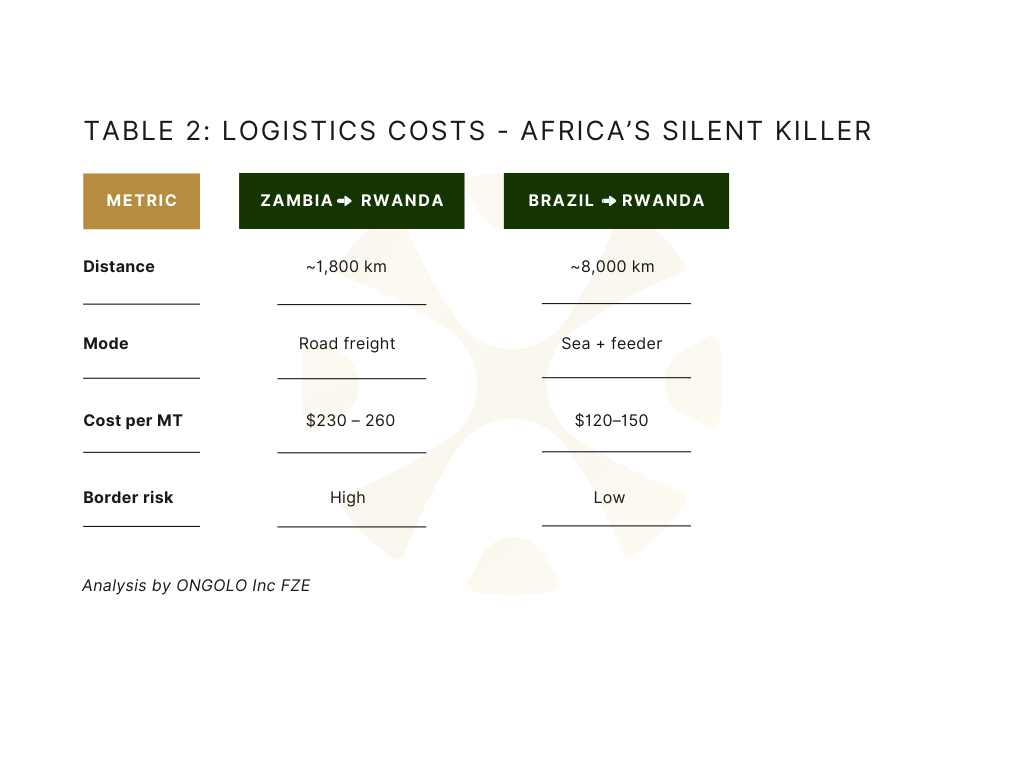
The sugar cost was $740 per MT ex-facto and $240 per MT for road transportation, bringing the total cost to $980 per MT landed. The total deal value was around $1.37m. This excluded the 20% import duty on sugar into Rwanda.
It would take 1-2 weeks to transport the containers by road. Plus another week for Zambia Sugar to do buyer due diligence and finalise the contract.
Why did the sugar deal fall through?
The deal fell through for several reasons.
Firstly, Zambia Sugar did not have stock because the sugar season runs from April to November. Had the commodity been in stock, we would have tried to negotiate a discount on the sugar and reached out to the Somali-owned trucking companies to get a better price on the transportation.

Secondly, the client preferred white sugar and Zambia Sugar only exports brown, unrefined sugar.
Lastly and perhaps more importantly, the landed price of Brazilian sugar, which is readily available, was $850 per MT or $200k cheaper for the total contract amount.
Why is Brazilian sugar cheaper than Zambian sugar?
There are several reasons why Brazilian sugar is cheaper than Zambian sugar.
Firstly, Brazil leverages economies of scale. Brazil is the world's largest sugar producer and exporter, benefiting from economies of scale that reduce production costs. However, it is worth pointing out that Zambia's agronomic performance is strong.
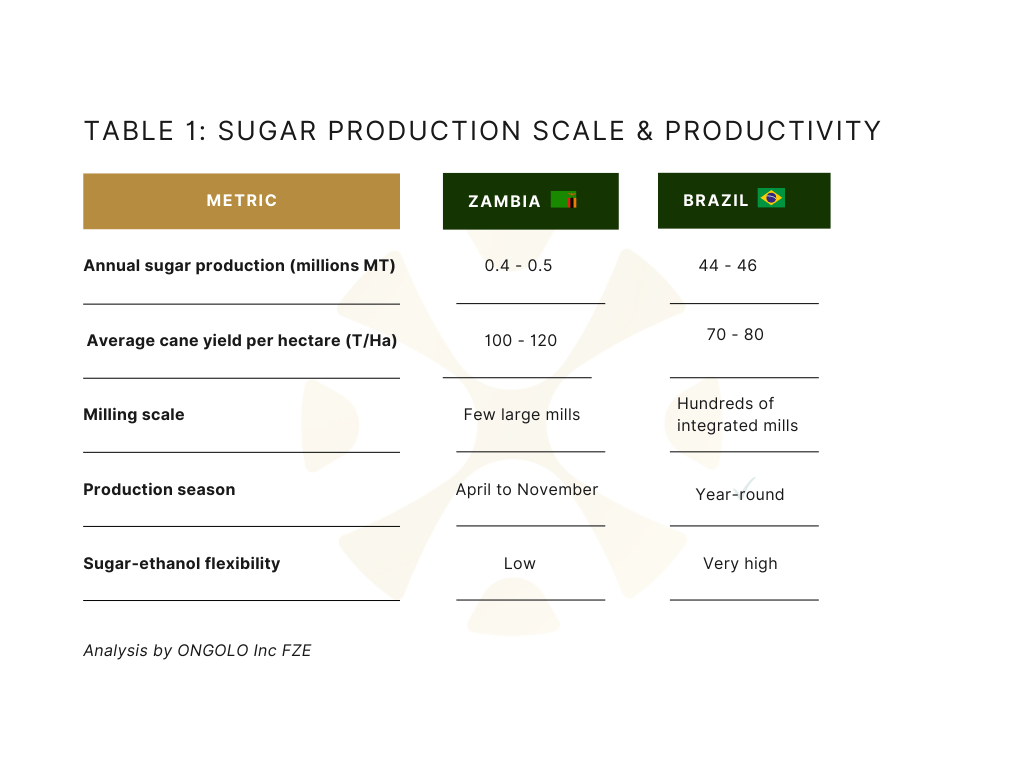
Secondly, while Zambia is closer to Rwanda than Brazil, logistics costs in Africa are disproportionately high. The reasons include: poor road and rail infrastructure; high fuel cost; and, expensive border crossings, with bureaucratic delays and corruption increasing costs. Brazil benefits from efficient maritime shipping routes, making bulk exports cheaper even over long distances.
Thirdly, Brazil exports sugar as a fully integrated ecosystem in which production, processing, financing, logistics, pricing, and risk management are tightly coordinated. By contrast, Zambia largely exports sugar as a standalone agricultural product moving through a fragment system. Limited production and refining coupled with logistical challenges can result in unmet demand.
Conclusion
The Zambia–Rwanda–Brazil sugar case illustrates Africa’s central trade paradox: proximity does not guarantee competitiveness. Until infrastructure, policy, and scale are addressed together, African markets will continue to import from outside the continent—even when regional supply exists.
The combination of economies of scale, cheaper shipping, lower subsidies, and high intra-Africa trade costs makes Brazilian sugar more competitive in price. This is a classic example of how structural inefficiencies in African trade make it cheaper to import goods from outside the continent rather than within Africa.
Are you looking for commodity suppliers in Africa? Contact us: hello@ongolo.com